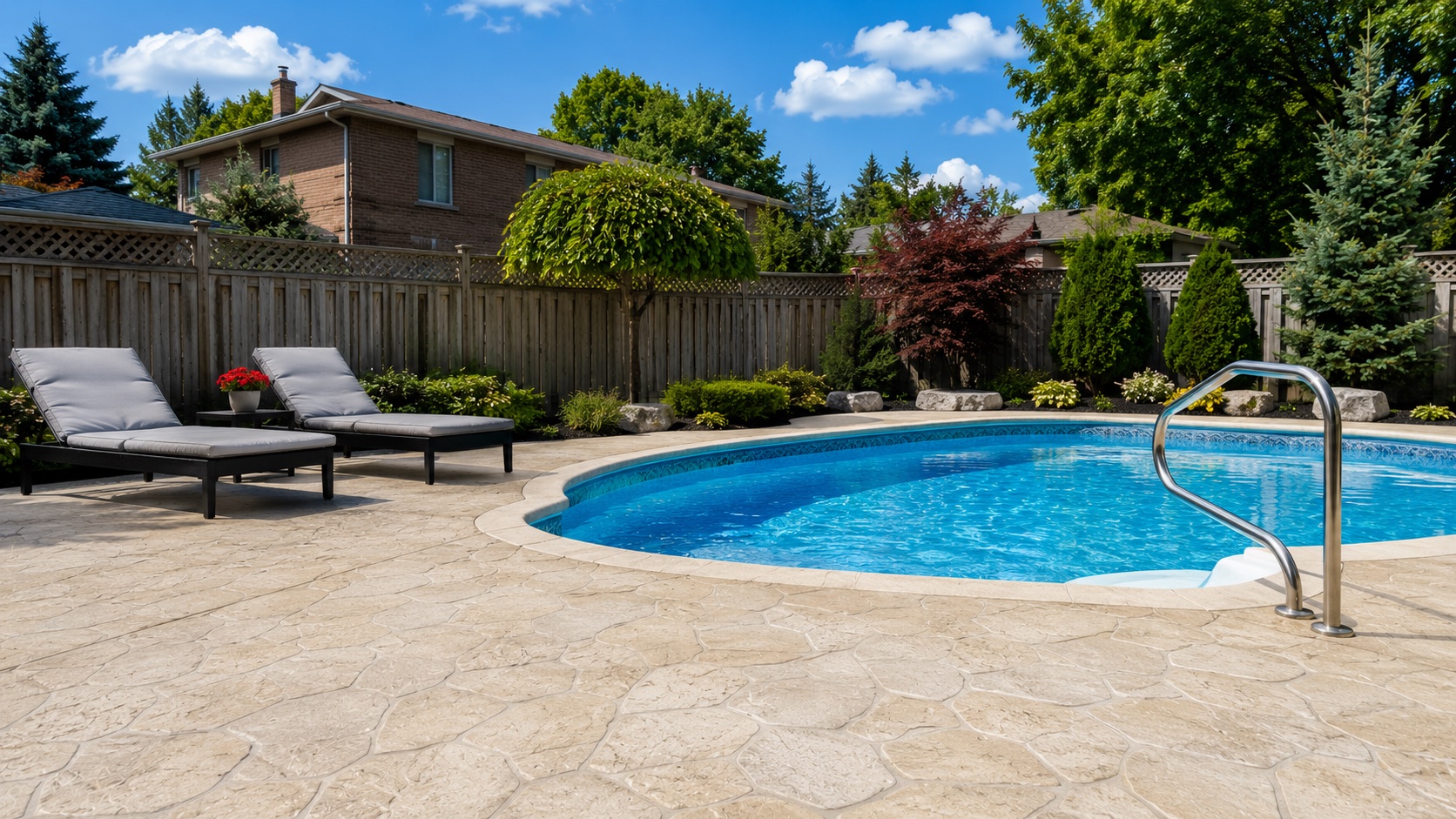
Every spring in the GTA, the same thing happens. Homeowners open up their backyards, take a real look at the pool deck for the first time in months, and feel that sinking feeling. The cracks are back. The surface looks faded, rough, or frankly embarrassing. And they start calling contractors for quotes on full replacement.
Then they get the number — $20,000, $28,000, sometimes more — and start looking for alternatives.
Here's what most Toronto homeowners don't realize until that moment: the concrete under your pool deck is almost certainly fine. What's failed is the surface — the top layer that took 20 years of Ontario freeze-thaw cycles, pool chemicals, and foot traffic. And that surface can be replaced without touching the slab underneath. In most cases, for 30–50 cents on the dollar of what replacement costs.
This guide covers everything — what resurfacing actually involves, which finishes work best around pool decks in the GTA climate, realistic costs for 2026, and what separates a long-lasting result from one that fails in three years.
Why Pool Decks Fail in the GTA
Ontario's climate is brutal on outdoor concrete. The cycle of freezing and thawing — which can happen dozens of times per season — forces water into microscopic cracks in the surface, expands them as it freezes, and gradually spalls the top layer of concrete. Combine that with pool chemicals (chlorinated water is mildly acidic and penetrates porous concrete surfaces), UV degradation from direct sun exposure, and years of foot traffic, and you've got a surface that was never designed to last indefinitely without maintenance.
The structural slab underneath — the thick pour that holds everything up — rarely fails. That's engineered to last 50+ years. What breaks down is the surface finish, and that's a much cheaper problem to solve than most homeowners assume.
"We got three quotes for full replacement — the lowest was $22,000. Resurfacing with Jewelstone cost $7,200 and looks better than new concrete ever did."
— Artisan Coat client, Oakville, 2025
Resurfacing vs. Replacement: What Actually Makes Sense
Replacement makes sense in a narrow set of scenarios: when the structural slab has heaved significantly (common near old tree roots), when there's widespread subsidence creating drainage problems, or when the entire layout needs to be redesigned. In those cases, you're dealing with a structural issue that no surface treatment can fix.
In every other scenario — cracking, spalling, fading, surface erosion, staining — resurfacing is the correct answer. The concrete underneath is doing its job. You're paying to fix what's visible and functional at the surface level, not to demolish and rebuild something that isn't broken.
| Option | Typical GTA Cost (400 sq ft deck) | Timeline | Disruption |
|---|---|---|---|
| Full Replacement | $18,000 – $35,000 | 1–2 weeks | Demolition, debris, landscaping damage |
| Concrete Resurfacing / Overlay | $4,500 – $9,500 | 2–4 days | None — no demolition required |
| Jewelstone Resurfacing | $6,000 – $12,000 | 2–3 days | None — applied over existing surface |
| Basic Sealing (surface intact) | $800 – $2,000 | 1 day | None |
The Best Pool Deck Finishes for Toronto's Climate
Not every finish that looks great in a California showroom will survive a Toronto winter. Here's an honest breakdown of what works — and what to watch out for — for GTA pool decks specifically.
Jewelstone Resurfacing
Jewelstone is our most recommended finish for pool decks in the GTA, and for good reason. It's a proprietary chip-and-binder system that creates a textured, slip-resistant surface with exceptional durability. The finish is non-porous, handles pool chemicals without staining, and is engineered to handle freeze-thaw cycles without cracking or delaminating. It's available in dozens of colour combinations — from natural stone tones to bold contemporary palettes. For pool decks that need to look polished and perform reliably through Ontario seasons, Jewelstone is hard to beat.
Concrete Overlay / Resurfacing
A polymer-modified concrete overlay bonds directly to the existing slab and can be textured, stamped, or stained to look like natural stone, slate, or brushed concrete. This is a cost-effective option for decks that are structurally sound but need a fresh look and improved slip resistance. The quality of the bond and the polymer content of the mix determines durability — this is not the place to cut corners on material quality.
Exposed Aggregate Overlay
Exposed aggregate finishes — where small stones are set into the surface and the top layer is washed away to reveal them — are among the most slip-resistant options available and are excellent for pool surrounds. The textured surface provides grip when wet and the aggregate itself adds visual interest. This finish hides future wear well and is extremely durable in freeze-thaw conditions when properly sealed.

Stamped Concrete Overlay
Stamped overlays replicate the look of natural stone, slate, travertine, or brick at a fraction of the cost. They're visually stunning but require careful sealer maintenance — particularly around pool decks where water and chemicals constantly contact the surface. A stamped overlay that's resealed every 2–3 years will last 15+ years. One that's neglected will begin to chip and fade within 5. Be upfront with your contractor about maintenance expectations before choosing this finish.
The #1 mistake homeowners make with pool deck resurfacing is choosing a finish purely on looks without asking about frost resistance and sealer requirements. A beautiful stamped finish that requires annual resealing to stay watertight around a pool is a maintenance commitment most people don't account for. Ask your contractor specifically: "How will this perform after 5 freeze-thaw cycles without resealing?" If they can't answer that question clearly, that's your answer.
What the Process Actually Looks Like
A professional pool deck resurfacing project in the GTA typically runs 2–4 days from start to finish — no demolition, no disposal trucks, and no damage to surrounding landscaping. Here's what to expect:
- Day 1 — Surface prep. The existing deck is power-washed, any cracks are filled and stabilized with appropriate repair mortars, and the surface is ground or acid-etched to create proper bonding profile. This step is everything. A resurfacing that fails within 3 years almost always failed because of inadequate prep, not bad material.
- Day 1–2 — Base application. The bonding agent and base coat are applied. For Jewelstone, the chip broadcast happens at this stage. For stamped overlays, the colour hardener and stamp pattern are applied while the material is workable.
- Day 2–3 — Finish and detail work. Edge work, expansion joint treatment, and any pattern or colour blending. This is where the quality of the crew shows most visibly.
- Day 3–4 — Sealing. A minimum of two coats of the appropriate sealer is applied. For pool decks, this typically means a penetrating sealer for the base and a topical sealer for the finish layer. The deck is ready for light foot traffic after 24 hours and full pool season use within 7 days.
What Does Pool Deck Resurfacing Cost in Toronto in 2026?
Cost is driven by deck size, surface condition, chosen finish, and complexity of the layout (steps, curved edges, and integrated planters all add time). Here are realistic numbers for the GTA market in 2026 — not the low-ball quotes that lead to disappointing results, but what professional work actually costs:
- Basic concrete overlay (plain or lightly textured): $9 – $13 per sq ft installed
- Exposed aggregate overlay: $11 – $16 per sq ft installed
- Stamped concrete overlay: $13 – $18 per sq ft installed
- Jewelstone resurfacing: $14 – $22 per sq ft installed
- Crack repair (before resurfacing): $150 – $600 per linear foot depending on severity
For a typical GTA pool deck of 400–600 square feet, total project costs generally land between $6,000 and $14,000 for a quality resurfacing — compared to $20,000–$35,000 for full demolition and replacement of the same area. The savings are real, and the result — when done right — is a surface that looks significantly better than raw concrete ever did.
How Long Does Pool Deck Resurfacing Last in the GTA?
Done properly, with quality materials and professional application, a pool deck resurfacing should last 10–20 years in a Toronto climate. The actual lifespan depends on three things: the quality of the surface preparation (the single biggest factor), the quality of the materials used, and how consistently the sealer is maintained.
Artisan Coat backs all resurfacing work with a 3-year warranty against delamination and cracking under normal use conditions. We also use only frost-resistant, polymer-modified systems specifically engineered for Ontario's freeze-thaw climate — not generic products imported from warmer markets that degrade quickly in our winters.
The 5 Questions to Ask Any Pool Deck Contractor
Before you sign any quote, get answers to these. The responses will tell you everything about whether you're dealing with a professional operation or someone who will be gone when problems show up:
- What's your crack repair protocol? Filling cracks with the overlay material is not adequate. A proper repair uses epoxy injection or flexible polyurethane repair compounds depending on the crack type. If they're vague, move on.
- What specific product system are you using? Get the brand and product name. Google it. If it's not a recognized professional-grade material, ask why.
- Is this product rated for freeze-thaw exposure? Non-negotiable for any GTA pool deck.
- How many sealer coats and what product? Two coats minimum, applied at the correct interval. Anything less is a shortcut.
- Do you have a warranty? In writing? A contractor confident in their work will put it in writing. One who isn't confident won't.