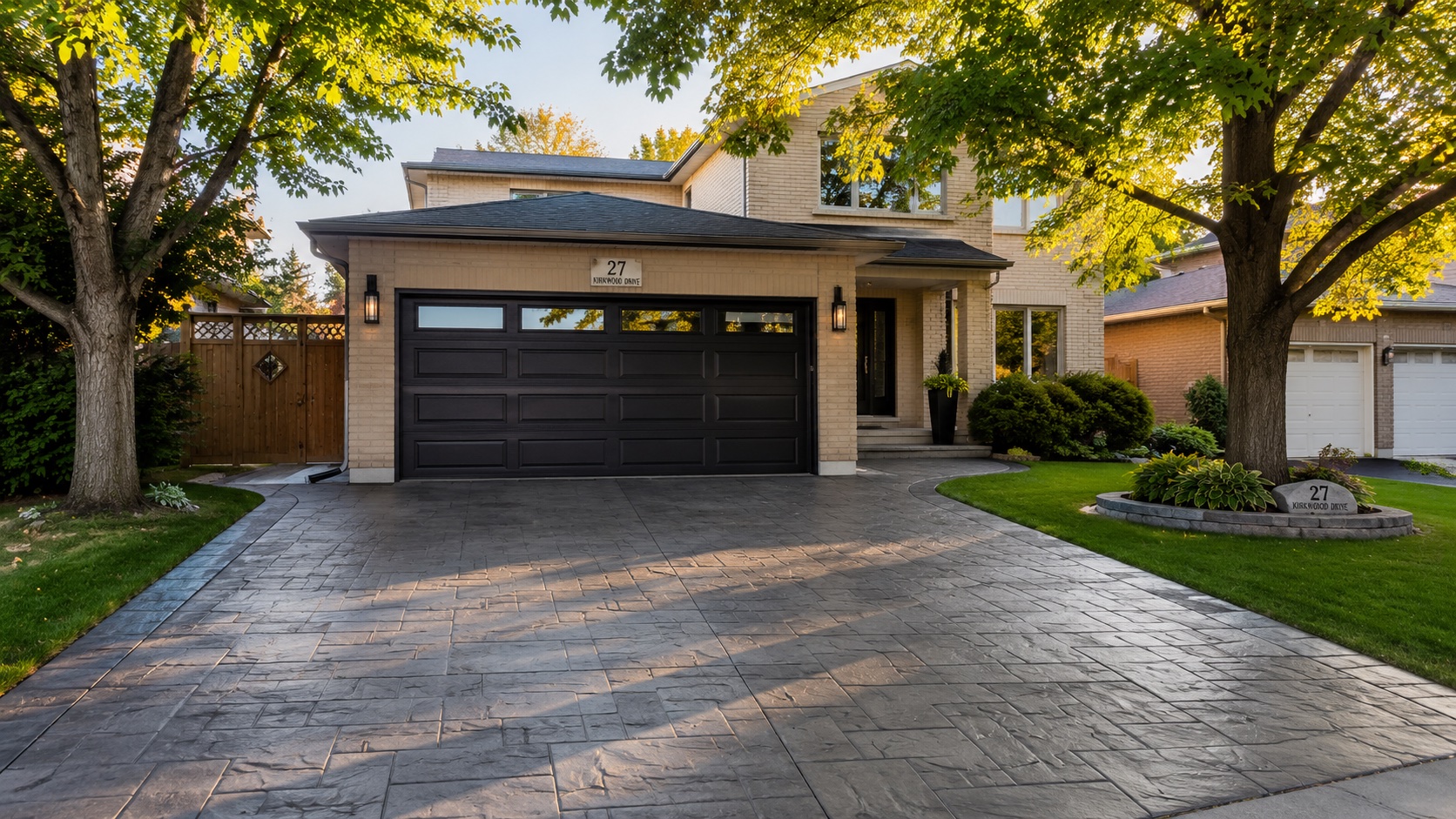
Every spring in Toronto, the same scene plays out across thousands of GTA homes. Winter revealed the damage. The porch is cracked, spalling, or stained. A contractor comes out, gives a quick look, and says: "You need to tear it out and start fresh." The quote lands somewhere between $12,000 and $25,000. And the homeowner, not knowing there's another option, starts mentally preparing to spend that money.
Here's what most contractors won't tell you: in the majority of cases, full concrete replacement is not necessary. Concrete resurfacing — applying a new decorative overlay over existing concrete — delivers results that are as good or better than replacement, at a fraction of the cost and without any of the demolition mess.
We've been doing this for over 14 years in the GTA. This article gives you the full, honest comparison so you can make a real decision — not one based on what a contractor needs to sell.
The Real Difference: What Each Option Actually Involves
Full Concrete Replacement
Full replacement means removing your existing concrete entirely — with jackhammers, bobcats, and a dumpster — disposing of it, forming new edges, pouring new concrete, and waiting for cure time. For a typical Toronto porch or patio, this is a 1–2 week process that involves significant noise, mess, and disruption. The end result is plain concrete unless you pay additionally for stamping, coloring, or sealing.
Concrete Resurfacing
Resurfacing means applying a polymer-modified overlay directly over your existing concrete. First, we assess and repair any structural issues — cracks are filled, spalled areas are rebuilt, the substrate is prepared to exact spec. Then, a decorative concrete coating is applied in your chosen color, texture, and pattern. The result is a finished, sealed surface that looks new — or better than new — without any demolition.
"The job that your first contractor said required full tear-out? In most cases, it didn't. What it needed was proper assessment and the right resurfacing system — not a demolition crew."
Side-by-Side Cost Comparison
These are real-world numbers for residential projects in the GTA in 2026. Costs vary by size, condition, and scope, but this gives you an accurate baseline:
| Factor | Full Replacement | Resurfacing |
|---|---|---|
| Typical porch cost (100–150 sq ft) | $8,000 – $18,000 | $2,500 – $6,000 |
| Typical patio cost (300–500 sq ft) | $15,000 – $35,000 | $5,000 – $14,000 |
| Pool deck (400–600 sq ft) | $20,000 – $45,000 | $7,000 – $18,000 |
| Demolition & disposal included | Yes (adds $2,000–$6,000) | Not required |
| Project duration | 1–3 weeks | 1–4 days |
| Disruption to property | High — jackhammers, dumpster, access blocked | Minimal — quiet, clean process |
| Decorative finish options | Limited unless you pay extra for stamping | Wide range of colors, textures, patterns |
| Canadian winter performance | Standard concrete — will crack over time | Polymer-modified — frost-resistant coatings |
| Warranty (Artisan Coat) | N/A | 3-year warranty on all resurfacing |
When Resurfacing Works — and When It Doesn't
Resurfacing is not a magic solution. There are cases where replacement truly is the right answer, and any honest contractor should tell you when that's the case. Here's how to tell the difference:
Resurfacing Is the Right Choice When:
- The concrete has surface cracks, spalling, or cosmetic deterioration
- The slab is structurally sound — meaning no heaving, major settling, or drainage issues
- You want a decorative finish rather than plain grey concrete
- You want to save money without sacrificing visual results
- You want the project done in days, not weeks
Replacement Is Necessary When:
- The slab has major structural failure — significant heaving, extensive base failure, or large areas of complete delamination
- There is a serious drainage problem that a surface coating can't solve
- The concrete has deep, through-cracks caused by tree roots or foundation issues (the root cause must be resolved first)
- Less than 25% of the surface is salvageable
If a contractor immediately quotes full replacement without a proper surface assessment — ask them to explain specifically why resurfacing isn't an option. A reputable contractor can clearly explain what's wrong with the substrate and why it can't be saved. If they can't, get a second opinion. In our experience, the majority of surfaces quoted for replacement are genuinely salvageable with proper prep and resurfacing.
What "Proper Prep" Actually Means
The most common reason resurfacing jobs fail isn't the coating — it's what happens before the coating goes down. The most important part of any resurfacing project is the preparation: diagnosing structural issues, filling and stabilizing cracks, repairing spalled areas, and profiling the substrate so the overlay bonds correctly.
A company that skips prep — grinding quickly and applying coating without addressing structural issues — will give you a result that looks great in photos for 60 days and then starts to fail. The coating will delaminate, crack along old lines, or separate from the substrate.
At Artisan Coat, prep is non-negotiable. We assess every surface before we quote. We repair all structural issues before we coat. If we believe a surface genuinely can't be saved, we'll tell you — and refer you to someone who does replacement. We'd rather lose a job than put our name on something that won't hold.
The GTA Factor: Why Freeze-Thaw Matters
This is specific to Toronto and the surrounding GTA — and most homeowners don't hear about it until they've had a surface fail.
Standard concrete, even freshly poured replacement concrete, is highly vulnerable to freeze-thaw cycling. Water enters microscopic pores in the concrete, freezes in winter, expands, and chips away at the surface. Unsealed or improperly sealed concrete in the GTA climate will begin to spall within 3–5 years. This is why so many driveways, porches, and pool decks look destroyed just a few years after installation.
Our Jewelstone resurfacing system uses polymer-modified overlays that are engineered for freeze-thaw performance. The material is flexible — it moves with temperature changes instead of cracking. Properly sealed with the right topcoat, these surfaces hold up to GTA winters far better than standard replacement concrete.

Real Numbers: What GTA Homeowners Are Spending
Based on jobs we've completed across Toronto, Mississauga, Brampton, Vaughan, and Oakville in 2025–2026:
- Front porch resurfacing (average size): $2,800 – $4,500
- Porch + stairs (combined): $3,500 – $7,000
- Pool deck resurfacing: $6,500 – $16,000 depending on size
- Driveway resurfacing: $4,500 – $12,000
- Patio or backyard pad: $3,500 – $9,000
Compare that to full replacement quotes our clients received from other contractors — almost universally 2–3x higher for the same area — and you understand why resurfacing has become the standard choice for GTA homeowners who've done their research.