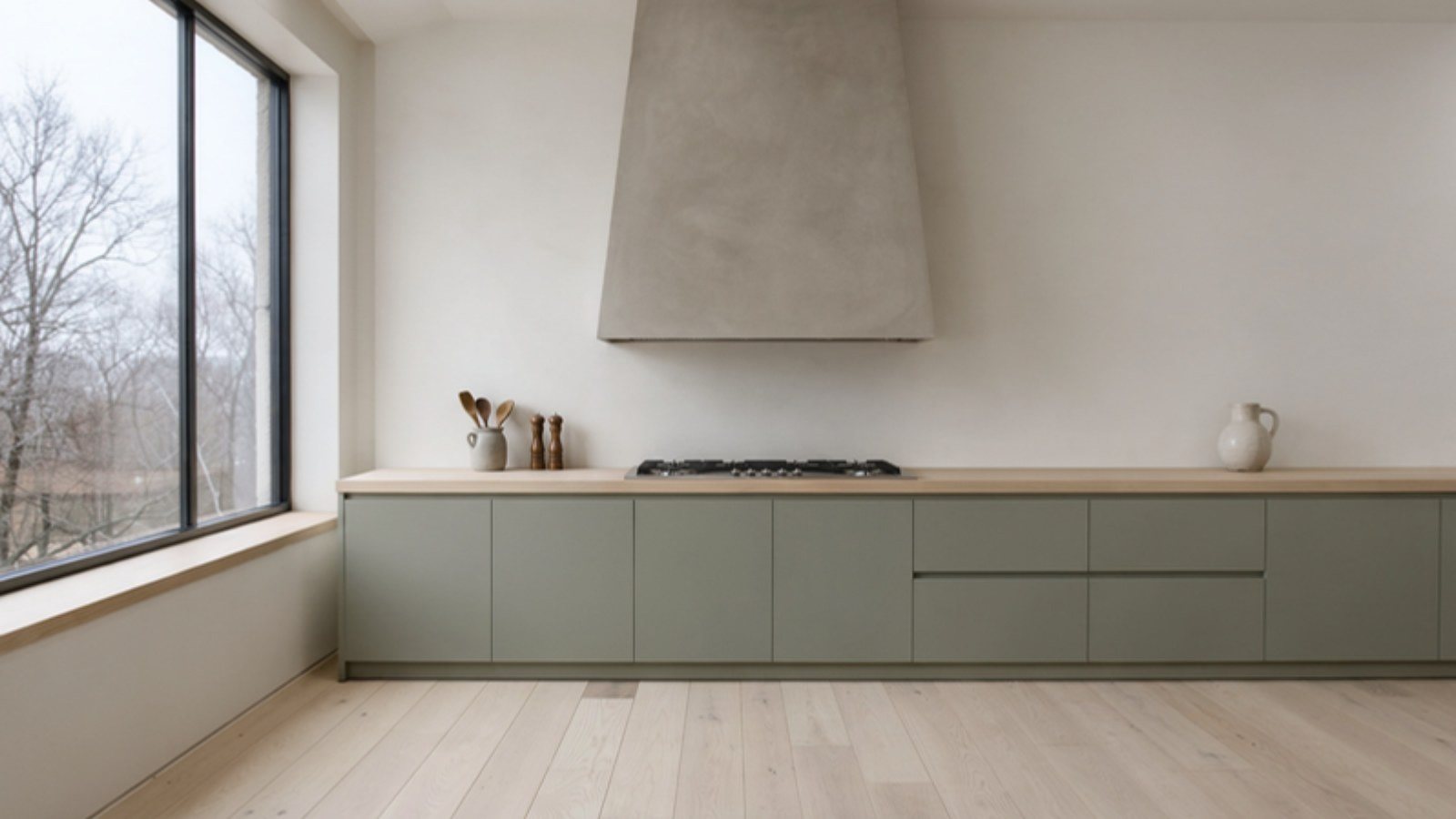
Walk through any 2026 kitchen feature in Toronto Life or House & Home and you will see the same thing: the range hood is no longer an appliance. It is the sculpture. Stainless chimney hoods are out. Plastered, seamless, stone-coloured hood covers that run straight into the ceiling are in, and designers are already calling bigger, more sculptural hoods the kitchen statement for 2027.
Here is what most contractors will not tell you: a traditional lime or Venetian plaster hood looks incredible on day one and then sits directly above the greasiest, steamiest spot in the house. Microcement gives you the same hand-troweled, mineral look with a sealed, wipeable surface that is built for a working kitchen. This is what a microcement range hood costs in Toronto, how it is built safely around the heat, and when you should skip it.
Why the Plaster-Look Range Hood Took Over GTA Kitchens
It anchors the room. In open-concept kitchens across Toronto, Vaughan and Oakville, the hood is the tallest object you see from the living room. A seamless mineral finish turns it into architecture instead of hardware.
It kills the visual noise. Stainless shows every fingerprint, and a tiled hood adds hundreds of grout lines at eye level. A troweled finish reads as one calm, continuous surface.
It works with every cabinet trend. Sage, olive, walnut, rift oak, matte black, warm white. Microcement is mixed to colour, so the hood can match the walls, contrast the cabinets, or carry the same tone as a microcement backsplash below it.
It is shape-flexible. Tapered chimneys, curved bell shapes, square boxes, a hood that disappears into a full-height feature wall. If it can be framed, it can be finished.
“A range hood is the one surface every guest sees and every cook touches. It has to look like stone and clean like glass. That is exactly the job microcement was made for.”
Microcement Range Hood Cost in Toronto (2026)
Interior microcement in the GTA runs roughly $15–$20 per square foot installed, but a range hood is not priced like a flat wall. It is small, full of corners and edges, and every outside corner has to be crisp. Most of the cost is detailing, not square footage. These are typical Toronto ranges; your quote depends on the shape, the height and whether the hood frame already exists.
| Scope | Installed Cost (GTA, 2026) | Typical Timeline |
|---|---|---|
| Finish an existing drywall hood box | $1,200 – $2,200 | 2 – 3 days |
| Curved or tapered hood, existing frame | $1,800 – $3,200 | 3 – 4 days |
| Hood plus matching backsplash | $2,800 – $5,200 | 3 – 5 days |
| Full-height feature wall with integrated hood | $4,000 – $7,000 | 4 – 6 days |
If you need a new hood frame built, a carpenter or your kitchen installer handles that first, usually a few hundred to a couple of thousand dollars depending on size and shape. For comparison, a custom plaster hood from a specialty trade, or a fully tiled hood with a new insert, commonly lands in the same range or higher, and neither gives you a sealed surface that shrugs off grease.
How a Microcement Range Hood Is Built Around Heat and Grease
This is where most plaster-hood horror stories come from. The finish is never the problem. The build behind it is.
- The insert does the work, the cover does the look. Every plastered or microcement hood is a decorative shell around a metal hood insert (the liner with the fan and filters). We never trowel onto the hot metal liner itself. The insert and ducting carry the heat and smoke; the shell stays at room temperature.
- Clearances come from the insert manual, not guesswork. Mounting height above the cooktop is set by the insert manufacturer, typically somewhere around 24 to 30 inches for most residential setups. Your installer follows that number before we ever arrive.
- The right board behind the finish. We prefer cement board or a primed, taped drywall shell with every joint and corner meshed. Hood boxes move with the house; mesh is what keeps hairline cracks from telegraphing through the finish.
- Two to three hand-troweled coats. Each coat is sanded before the next. This is where the soft cloudy movement comes from, and why no two hoods look identical.
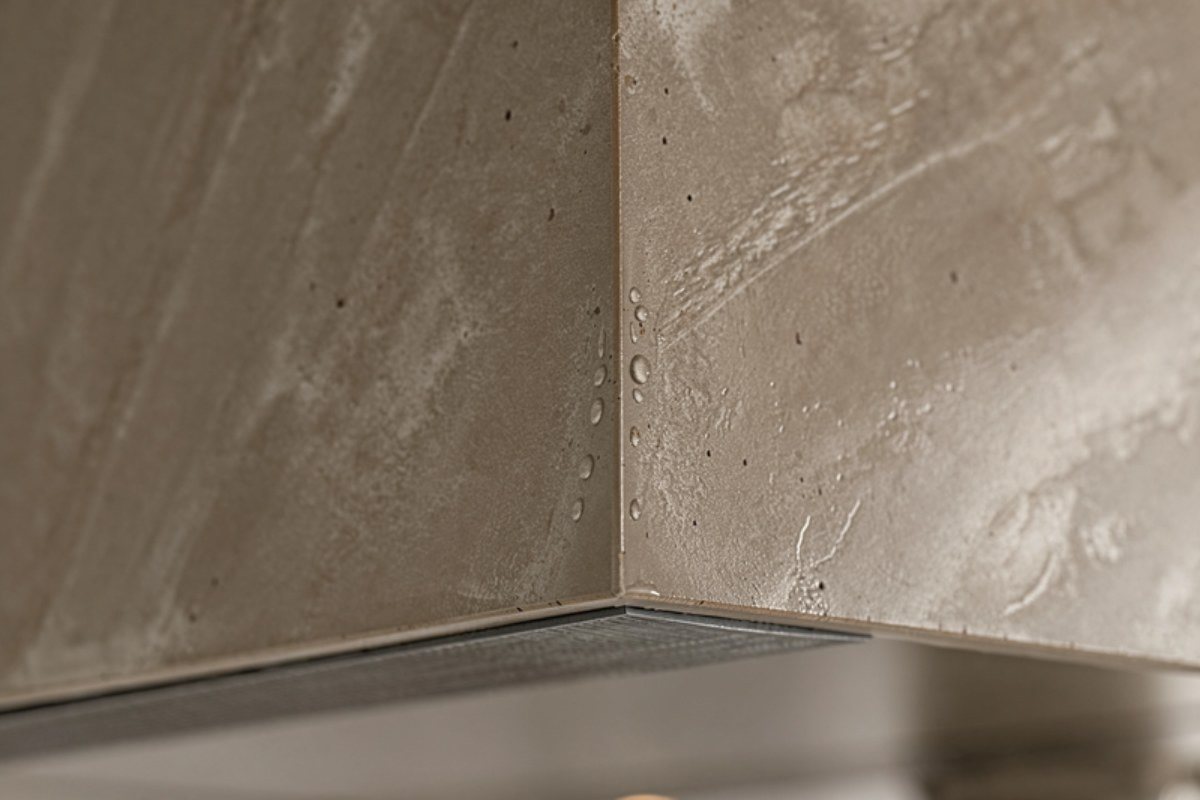
- A kitchen-grade sealer. The hood gets a durable, grease- and stain-resistant sealer system, not a decorative wax. Cooking splatter wipes off instead of soaking in.
- A clean bottom edge. The underside lip, where the shell meets the insert, gets either a crisp returned microcement edge or a slim metal trim so the finish never chips where filters come in and out.
If you already have a stainless chimney hood, do not coat it. Paint and coatings fail on stainless steel that heats and flexes. The right move is to build a framed cover around a hood insert, then finish the cover. Also check your fan size before you fall in love with a huge hood: very powerful fans in tight new GTA builds can need make-up air, so ask your HVAC contractor or kitchen supplier early. Getting that sorted before the finish goes on saves you from cutting into a brand-new surface later.
Microcement Range Hood Design Ideas for Toronto Kitchens
- Tone-on-tone with the walls. Hood and walls in the same warm greige so the hood reads as part of the architecture. Quiet luxury, very popular in new Vaughan and Richmond Hill builds.
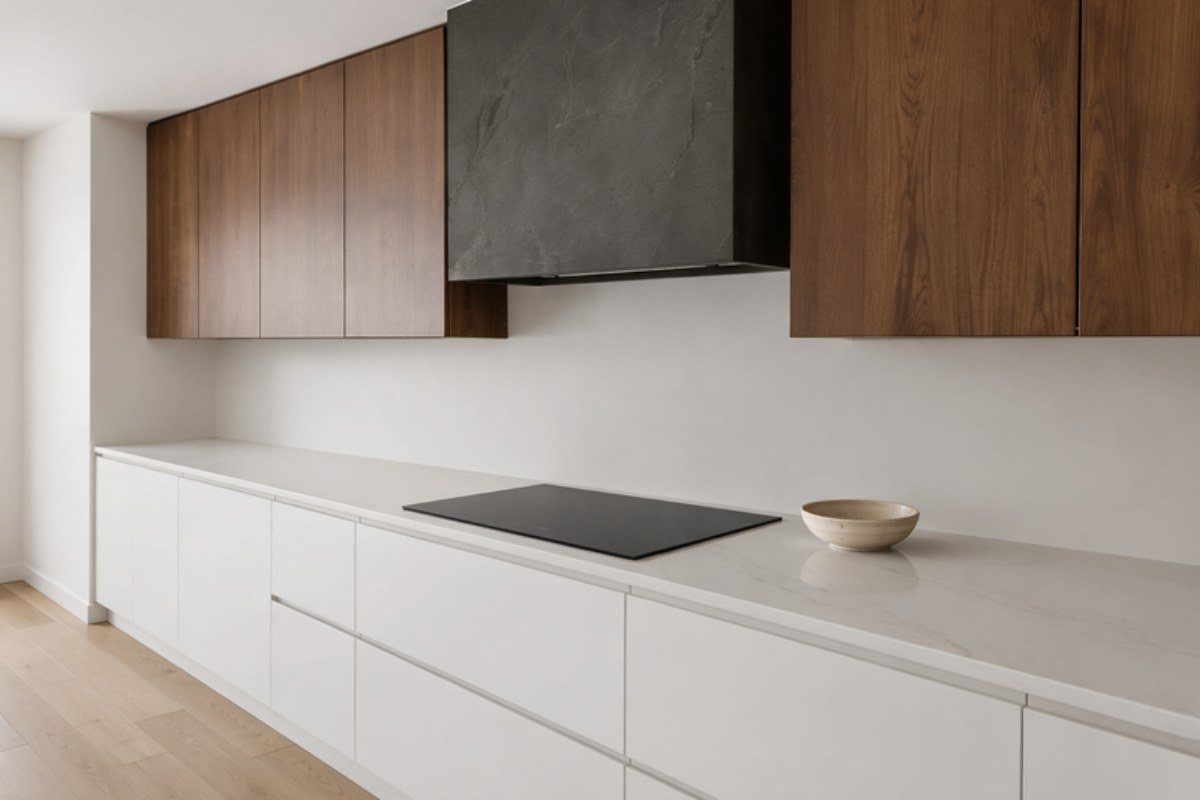
- Dark hood, light kitchen. Charcoal or deep taupe over white or oak cabinets. A bold focal point that works even in a compact Toronto condo.
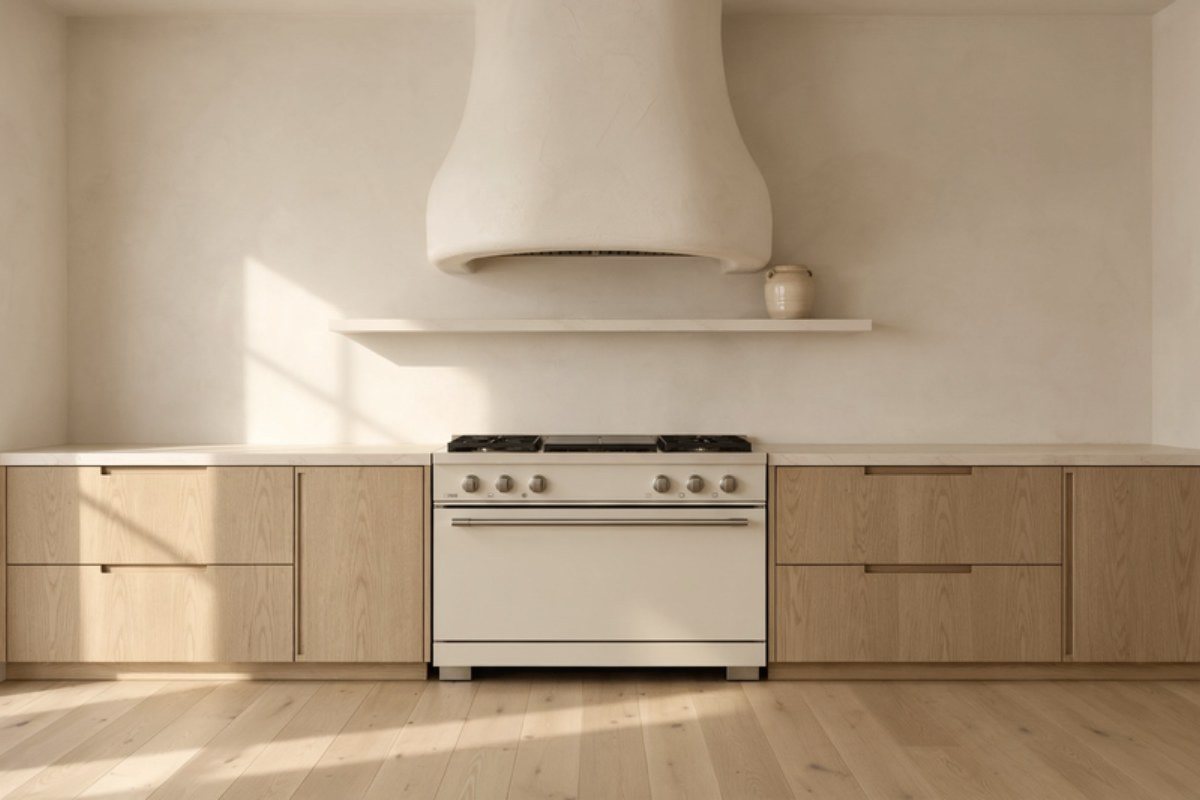
- Curved bell hood. The softer, European farmhouse shape. Best in larger detached kitchens in Oakville, Burlington and Mississauga.
- Hood plus backsplash as one surface. Run the microcement from counter to ceiling, hood included. No grout, no seams, nothing to scrub.
- Floating ledge under the hood. A thin oak or stone shelf for oils and salt keeps the look styled without clutter.
Cleaning and Living With It
Wipe the hood weekly with a soft cloth and a pH-neutral cleaner. For cooking splatter, a mild kitchen degreaser diluted in warm water is fine; skip bleach, vinegar, scouring pads and abrasive powders, which dull the sealer. Give the sealer time to fully cure before heavy frying underneath, and plan a light re-seal every few years. That is a half-day maintenance visit, not a renovation.
When We Tell You Not to Do It
- Your hood is a bare stainless chimney. It needs a cover built first. Coating the metal is a guaranteed failure.
- The frame is soft, cracked or moving. Fix the structure. A thin finish will not hide a box that flexes.
- You want a perfectly flat, uniform colour. Microcement is hand-troweled and has movement by design. If you want flat, paint it.
- Your budget is under about $1,200. Below that, a quality limewash or paint on the hood box is the smarter spend.
Where We Work
Artisan Coat finishes microcement range hoods, backsplashes, countertops and feature walls across Toronto, Mississauga, Brampton, Vaughan, Oakville, Etobicoke, North York, Scarborough, Richmond Hill, Markham, Burlington and the wider GTA. One crew handles prep, finish and sealer, backed by a 3-year written warranty and 20+ years of surface work.
The Short Version
A microcement range hood gives you the plastered, sculptural focal point every 2026 kitchen is chasing, with a sealed surface that actually survives cooking. In Toronto, finishing an existing hood box runs about $1,200–$2,200, curved hoods $1,800–$3,200, hood plus backsplash $2,800–$5,200, and a full feature wall $4,000–$7,000. Most jobs take two to six days with no demolition.
Build it around a proper insert, mesh the frame, use a kitchen-grade sealer, and sample the colour against your cabinets. Do that and the hood becomes the piece people photograph, not the one you scrub.