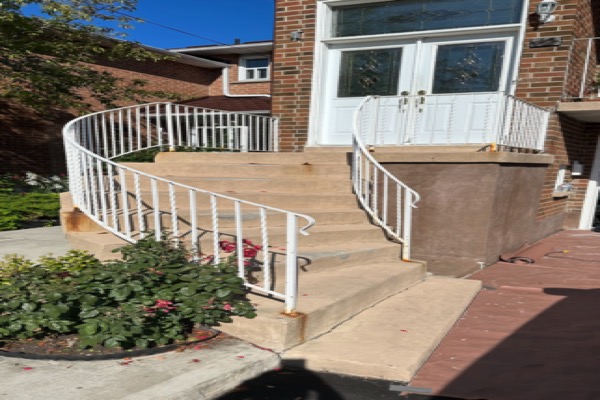
Concrete is one of the most forgiving materials in your home — until it isn't. The damage that's cheapest to fix is the damage almost nobody notices. By the time most homeowners call us, the small repair window has closed and what could have been a $1,500 job is now a $7,000 one.
The good news: every serious concrete problem starts with a visible warning sign. If you know what to look for, you can catch issues early — when resurfacing or repair still works, and before replacement becomes the only option.
Here are the eight signs every Toronto homeowner should walk outside and check this week.
1. Hairline Cracks (The "It's Probably Fine" Trap)
Thin cracks — less than the width of a credit card — are the most common form of concrete damage in the GTA. Most homeowners ignore them. That's usually the wrong call.
Hairline cracks themselves aren't structural. But they're entry points. Once water gets in, our freeze-thaw cycles do the rest: the water expands when it freezes, prying the crack wider every winter. A hairline crack you ignored in March is often a quarter-inch gap by November.
What it means: Cosmetic now, structural later. Seal or resurface within 1–2 seasons to prevent escalation.
2. Crumbling or Flaking Surface (Spalling)
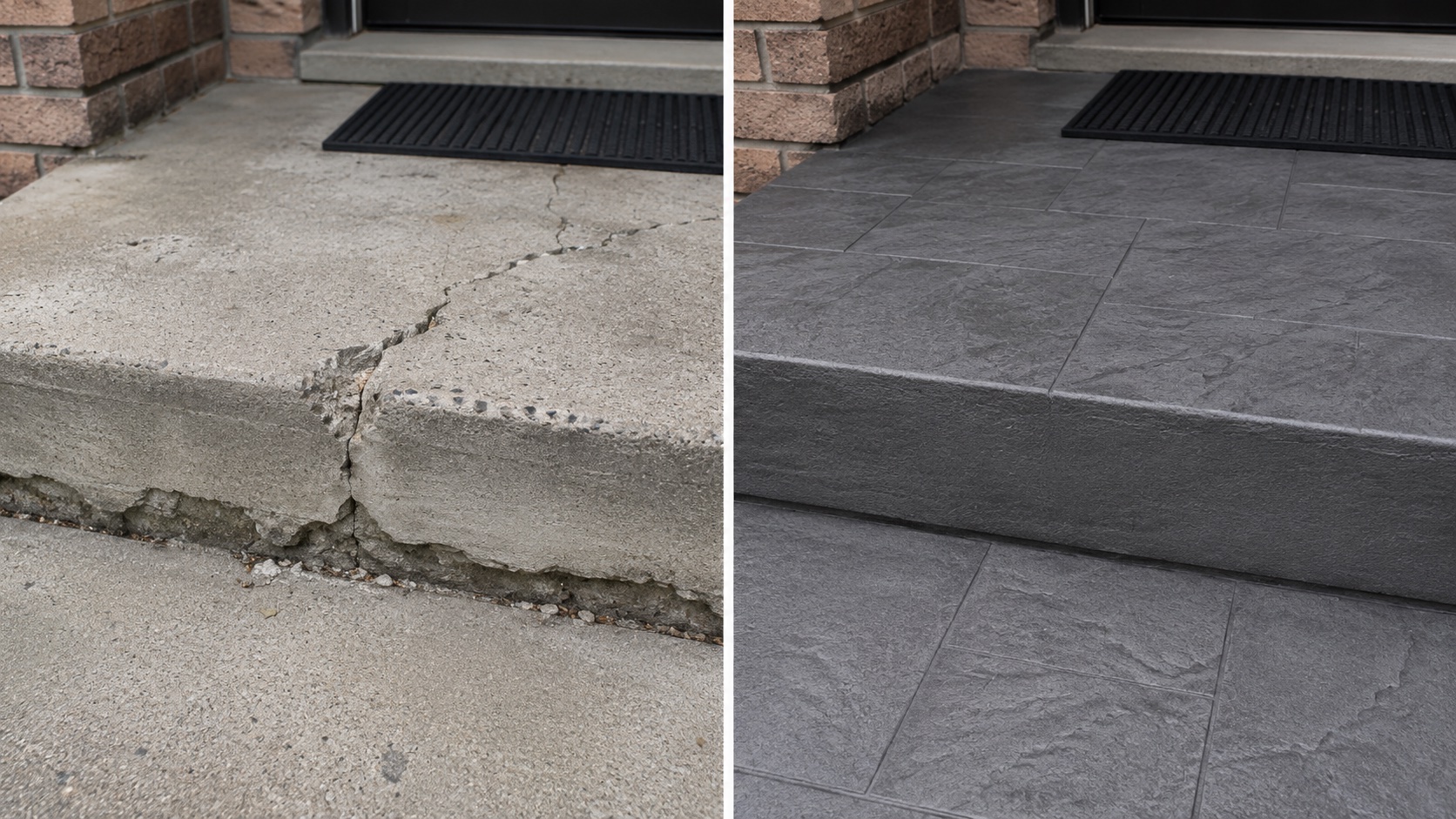
If small chips, flakes, or pebble-sized pieces are coming loose from the surface — especially on stairs, porches, or pool decks — that's called spalling. It's the most common visible damage we see across the GTA, and it's almost always caused by a combination of de-icing salt, water penetration, and freeze-thaw cycling.
Spalling is a clear signal that the surface layer of the concrete has lost its bond with the substrate. Once it starts, it accelerates — and the longer you wait, the deeper it goes.
What it means: The top layer is failing. Surface-only spalling is an excellent candidate for resurfacing. Deep spalling that exposes aggregate may require structural repair first.
De-icing salt is the single biggest enemy of GTA concrete. If you've been salting your porch or stairs every winter and you're seeing flaking, the two are almost certainly connected. After resurfacing, switch to sand or calcium-magnesium acetate — they're far gentler on concrete.
3. Stair Risers That Sound Hollow
Tap your porch stairs gently with the handle of a screwdriver. A solid, healthy step gives a sharp "tink." A delaminating step gives a hollow "thunk."
That hollow sound means the surface layer has separated from the layer underneath. You can sometimes catch this before any visible damage appears — and that's the best possible time to act. Once a delaminated section actually breaks loose, you're looking at a much bigger repair zone.
What it means: Repair window is closing. Resurfacing while it still sounds tight beats waiting until pieces fall off.
4. Stains, Dark Patches, or Persistent Wet Spots
Concrete is porous. When it's stained, that's not just a cosmetic problem — it's evidence of water sitting in the surface, which means the sealer (if there ever was one) has failed.
Pay particular attention to dark patches that don't fully dry after rain, or areas that look damp days after a storm. These spots are absorbing water faster than they can release it, and that water is doing damage every freeze-thaw cycle.
What it means: Sealer has failed. Without resealing or resurfacing, those wet spots will turn into spalling within 1–3 winters.
5. Cracks That Run Along an Edge or Corner
Cracks that hug the edge of a porch slab, the corner of a step, or the lip of a pool deck deserve immediate attention. Edge cracks tend to be structural rather than cosmetic, because they often indicate movement or settlement in the substrate beneath.
Common causes in the GTA include soil settlement (especially on newer builds), poor original concrete pouring practices, or root pressure from nearby trees.
What it means: Could be structural. A skilled assessor needs to look at it in person. Don't resurface over edge cracks without diagnosing the cause first.
6. White Crusty Residue on the Surface (Efflorescence)
That powdery white film that shows up on concrete and brick? It's called efflorescence, and it's mineral salts being pushed out of the concrete by moisture moving through it.
Efflorescence by itself isn't damaging — but it tells you that water is actively migrating through your concrete. That's a problem in winter, and a slow-burning one in any season. If you've cleaned it off and it keeps coming back, your concrete is functioning like a sponge.
What it means: Water management issue. Resurfacing with a proper sealing system shuts down the moisture migration that creates it.
7. Rust Stains Coming Through the Surface
Brown or orange streaks on the surface of your concrete usually mean one of two things: surface contact rust (a nail, a metal pot, a metal railing leaking onto the slab), or — more seriously — corrosion of the steel rebar embedded inside the concrete itself.
Surface rust is just a stain. Rebar corrosion is structural. The way to tell the difference is location: rust appearing along a straight line, near a railing, or in a regular pattern almost always means the steel inside is corroding. That's a problem you need a professional to assess.
What it means: If it's surface contact, clean and seal. If it's internal rebar corrosion, you may need full replacement of that section.
8. Sloping, Settling, or Sections That Have Dropped
If one corner of your porch or pool deck has visibly sunk relative to the rest — or if water now pools in the middle when it didn't before — you have a substrate problem, not a surface problem.
This is the one warning sign on this list where resurfacing alone won't help. The slab itself is moving. The fix involves either lifting the slab (mudjacking or polyurethane foam injection), partial replacement, or — if the slab is too far gone — full replacement.
What it means: Substrate failure. Need an in-person assessment before any cosmetic work is considered.
The Quick Self-Check Walk-Through
Here's a 10-minute walk-around you can do this weekend. Bring a flashlight (helps spot fine cracks) and a screwdriver (for the tap test).
- Front porch: Look at all stair risers, the porch surface, and especially the front edge. Tap each step. Note any hollow sounds.
- Walkway: Walk slowly. Note any cracks wider than a credit card, any settled sections, any spots that always seem damp.
- Driveway: Inspect for spider-web cracking, edge crumbling, and pitting (small holes from de-icing salt damage).
- Pool deck: Pay special attention near the coping (the edge where deck meets pool). Damage almost always starts there.
- Back patio: Check for staining, efflorescence, and pulling away from the foundation of the house.
- Stair treads (inside or outside): Hairline cracks across the tread are common and almost always cosmetic. Cracks along the front edge of the tread are more concerning.
When in Doubt, Photograph It
If you spot something and you're not sure how serious it is, the fastest free advice you'll ever get is to take a few photos and send them to a contractor who knows what they're looking at. We answer photo questions on WhatsApp daily, and we'll tell you straight: is it nothing, is it something to monitor, or is it something to fix this season?
The decision tree for almost every concrete problem on this list comes down to how big is the affected area, how deep does it go, and is the substrate underneath sound? An experienced eye can usually answer all three from a few good photos.
What Damage Catches Resurfacing — and What Pushes You to Replacement
- Surface spalling, flaking, hairline cracks, stains, sealer failure: Excellent candidates for resurfacing.
- Localized cracks, broken edges, isolated damage: Repair + resurface combo.
- Multiple wide cracks, hollow sections, partial slab failure: Structural repair first, then resurface. Often still much cheaper than replacement.
- Major settlement, severely heaved slab, exposed and corroded rebar: Replacement may be the right call.
The honest reality is that most concrete damage in the GTA falls into one of the first three categories. Full replacement is rarely necessary when the substrate underneath is sound — and demolition is almost never worth the cost or the mess if it can be avoided.