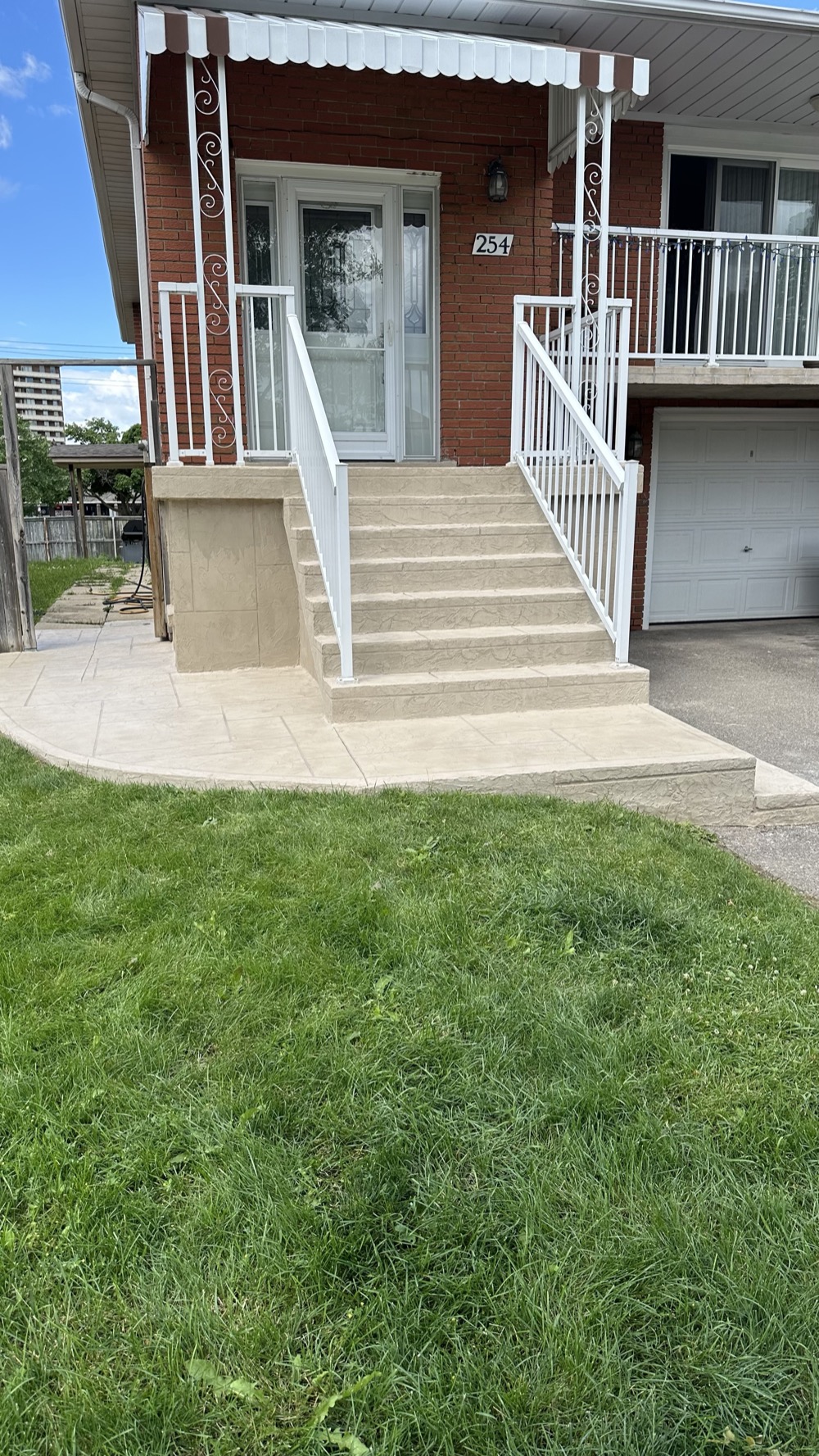
Sealing and staining get talked about as one service. They're two different jobs that happen to be done at the same time, and confusing them is how homeowners end up disappointed — expecting a colour change and getting a wet-look shine, or expecting winter protection from a product that was only ever decorative.
Here's what each one actually does, what it costs in the GTA, and why October is the month it matters most.
Sealing vs. Staining: Two Different Jobs
| Sealing | Staining | |
|---|---|---|
| Purpose | Protection — blocks water, salt and stains | Appearance — adds colour and depth |
| What it does | Fills or coats the pore structure | Reacts with or deposits pigment in the surface |
| Changes colour? | Slightly — can deepen tone or add sheen | Yes, that is the point |
| Needed for winter? | Yes | No |
| Repeat interval | Every 2–5 years depending on exposure | Long-lasting; protected by the sealer over it |
Stained concrete still needs sealing. In fact it needs it more — the sealer is what stops the colour being bleached by UV and eaten by salt.
What Unsealed Concrete Goes Through in a GTA Winter
Concrete looks solid. At a microscopic level it's a sponge, threaded with capillary pores that pull in water. That's the whole problem.
- Water enters the pores. Rain, snowmelt, slush tracked off the driveway.
- It freezes and expands. Water gains roughly nine percent in volume when it turns to ice, and it has nowhere to go but outward against the surrounding paste.
- The surface fractures from the inside. First invisibly, then as the fine crazing and flaking called spalling.
- Salt makes it worse in two ways. De-icing salt is hygroscopic — it pulls additional moisture into the concrete and holds it there. It also drives more freeze-thaw cycles by repeatedly melting and refreezing the same water at temperatures where it would otherwise stay frozen.
Toronto and the surrounding region go through dozens of freeze-thaw cycles in a typical winter. A sealed surface sheds most of that water before it can get in. An unsealed one absorbs it.
Pour a cup of water on your porch or driveway. If it beads and sits on top, your sealer is still working. If it soaks in and darkens the concrete within a few seconds, the sealer is gone — and so is your winter protection.
The Two Families of Sealer
Penetrating sealers
These soak into the concrete and react chemically below the surface, usually silanes, siloxanes or silicates. They leave the look of the concrete essentially unchanged — no shine, no film.
- Best for: driveways, walkways, exposed broom-finish concrete, anywhere traction matters
- Strengths: nothing to peel or flake, excellent freeze-thaw and salt resistance, no change in slip resistance
- Trade-off: no enhancement — your concrete looks exactly as it did
Topical (film-forming) sealers
These sit on the surface as a thin protective film — acrylics, polyurethanes, epoxies. This is the category that produces the wet look and the colour pop on decorative and stamped concrete.
- Best for: decorative, stamped and stained surfaces, porches, patios, pool surrounds
- Strengths: enhances colour and depth, easy to clean, protects stain from UV
- Trade-off: can become slippery when wet unless a grit additive is used, and needs renewal more often because the film wears
A glossy sealer on front steps without an anti-slip additive is a liability every time it rains or ices over. Any competent contractor will offer it. If it is not mentioned in your quote, raise it.
Staining: Acid vs. Water-Based
Acid stain reacts chemically with the lime in the concrete to produce mottled, variegated, stone-like tones. The results are permanent and genuinely beautiful, but they're also partly unpredictable — the existing concrete's chemistry influences the final colour. Palette is limited to earth tones: browns, tans, soft greens, warm greys.
Water-based stain deposits pigment rather than reacting. The colour range is far wider and the result is more predictable and more uniform. It sits closer to the surface, so the sealer protecting it is doing more of the work.
Worth being clear about a limit here: staining works with the surface you already have. It will not hide spalling, patch repairs, or a surface that has lost its finish. If the concrete is damaged rather than just tired, staining will faithfully highlight every flaw. That's the point at which resurfacing is the honest recommendation instead — a new wearing surface, colour included.
What It Costs in the GTA
Sealing is priced by area and condition. The variables that move the number are surface preparation, whether old failed sealer needs stripping, and the product class.
- Sealing alone is a maintenance-scale job — far less than resurfacing, and the cheapest insurance available against freeze-thaw damage.
- Stain plus seal costs more than sealing alone because it adds surface prep, colour application and additional cure time.
- Resurfacing — a new decorative surface rather than a treatment of the old one — typically runs $1,800 – $4,500 for a porch or steps and $3,500 – $7,000 for a driveway or larger patio in the GTA.
The decision is usually straightforward. If the surface is sound and you want it protected or recoloured, seal or stain. If the surface itself has failed, treating it is money spent twice. Our cost guide breaks the resurfacing numbers down by surface type.
Why October Is the Month
Sealing before winter is the single highest-return maintenance task on a GTA property, because it is specifically the thing that stops salt and meltwater entering the concrete during the months they're present.
But sealers have application conditions of their own, and they're often stricter than the overlays beneath them:
- The surface must be genuinely dry — typically at least 24 to 48 hours after any rain.
- Temperature needs to sit in the product's working range, usually around 10°C or above, for both application and cure.
- There must be enough daylight and warmth left in the day for the sealer to cure before evening dew settles. This is what quietly ends the sealing season — not the daytime high, but how early the dew point arrives.
Which is why the practical sealing window closes earlier in the fall than people expect. A mild late-October day with a 4:45pm sunset and heavy evening dew may not give a sealer the cure time it needs.
How Often to Re-Seal
| Surface | Typical interval | Why |
|---|---|---|
| Driveway | 2–3 years | Vehicle traffic, direct salt load, plow contact |
| Front steps & porch | 3–5 years | Foot traffic and salt, less abrasion |
| Patio | 3–5 years | UV and weather, minimal salt |
| Pool deck | 2–3 years | Constant water, pool chemicals, sun |
| Stamped / decorative | 2–3 years | Film-forming sealer wears; colour needs UV protection |
Use the water-bead test rather than the calendar. Surfaces age at different rates depending on exposure, drainage and how much salt they see.
Three Mistakes Worth Avoiding
- Sealing over a dirty or damp surface. You trap whatever is underneath. Trapped moisture is the most common cause of a sealer clouding or peeling within a season.
- Applying it too thick. More is not better with film-forming sealers. Over-application leads to bubbling, blushing and an uneven finish. Two thin coats outperform one heavy one every time.
- Sealing concrete that needs repair. A sealer is not a structural product. Over active spalling or working cracks, it buys months, not years.
What to Ask Before You Hire
- Penetrating or film-forming — and why that one for my surface? There should be a reason tied to how you use the space.
- What is the product name? Look it up. A professional will tell you without hesitating.
- Is it rated for freeze-thaw and de-icing salt? Non-negotiable anywhere in the GTA.
- How many coats, and is an anti-slip additive included? Two coats minimum on most exterior work.
- What is the honest re-seal interval for my surface? Anyone claiming a permanent exterior sealer is overselling.
Artisan Coat has sealed, stained and resurfaced concrete across Toronto, Mississauga, Brampton, Vaughan, Oakville and the wider GTA since 2012. If your surface only needs sealing, we'll tell you that — it's a smaller job than resurfacing and it's frequently the right one.